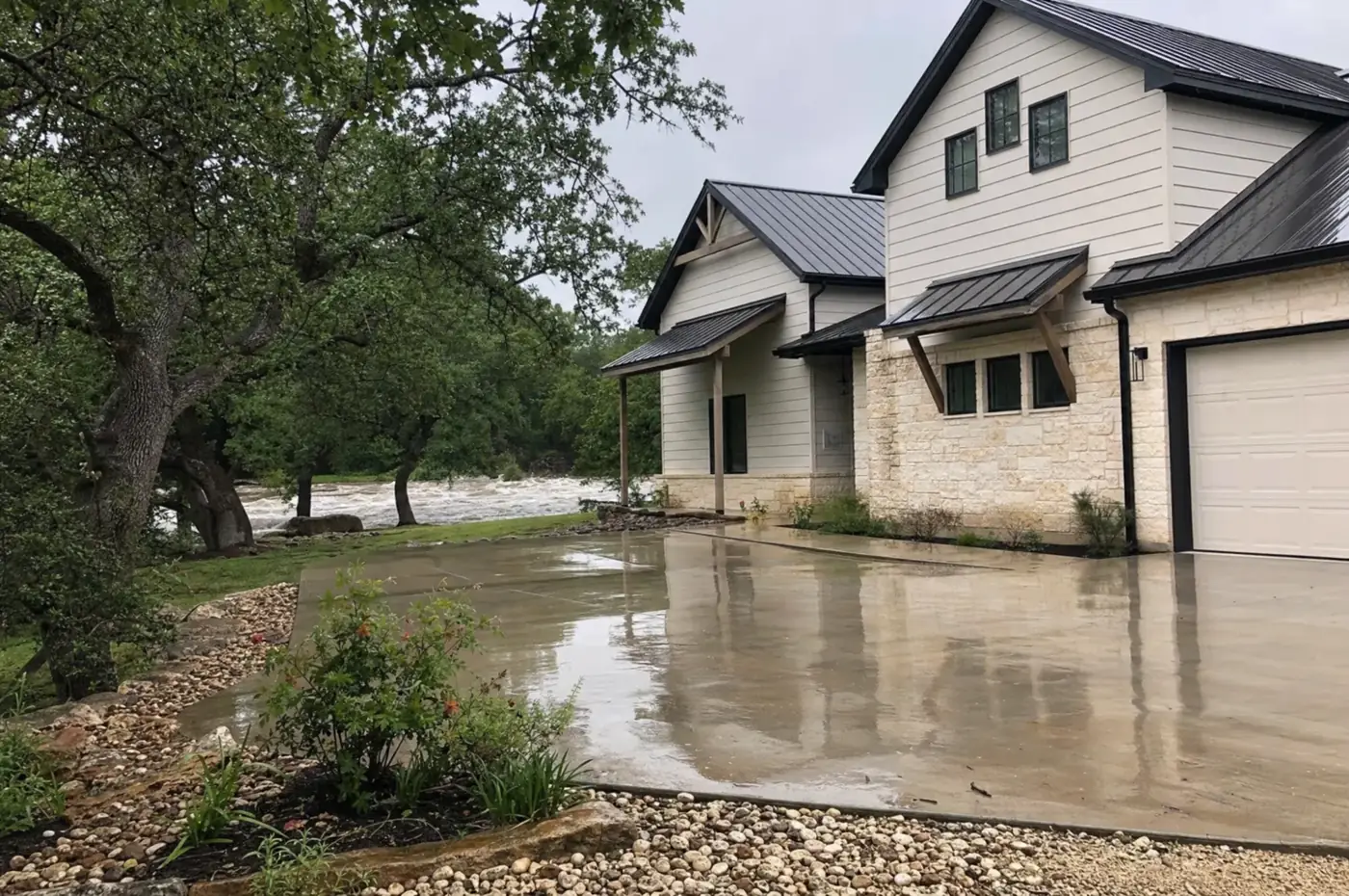
Austin sits on the eastern edge of the Hill Country, right in the middle of what forecasters call Flash Flood Alley. Rain that falls on the thin soil and limestone west of town runs off fast, and creeks that are dry most of the year can rise several feet in an hour. Shoal Creek, Waller Creek, Walnut Creek, Williamson Creek and Onion Creek all run through neighborhoods, and Onion Creek in particular has flooded homes more than once, including in the Halloween floods of 2013 and the Memorial Day floods of 2015.
Most water damage calls in Austin don't start with a storm, though. They start inside the house, with a water heater in the garage, a refrigerator line, a washing machine hose, or a pipe under the slab.
What drives water damage in Austin homes
Clay soil and slab leaks
Much of Austin, especially east of MoPac and I-35, is built on expansive clay that swells when wet and shrinks in drought. That movement stresses foundations and the water lines running under them. A slab leak often shows up as a warm patch of floor, damp carpet along a wall, cupped wood flooring or a water bill that keeps climbing. A plumber locates and repairs the leak. The restoration side dries the slab and the floor coverings above it.
Freezes
Austin rarely stays below freezing for long, so plenty of homes have pipes in exterior walls, attics and garages with little insulation. When a hard freeze does arrive, as it did in February 2021, pipes split and the water often starts running when they thaw. Older homes in neighborhoods like Hyde Park, Travis Heights and Clarksville can have original galvanized or copper plumbing that fails first.
Attic AC leaks
Long cooling seasons mean AC systems in Austin attics run hard for months. When a condensate line clogs or a drain pan rusts through, water drips into insulation and then through the ceiling. A brown ring on the ceiling under the air handler is the usual first sign.
Water extraction in Austin
The most common search we see from Austin is for water removal and water extraction, and that's where most jobs begin. A crew pulls standing water out of carpet and hard floors, maps moisture in the walls and slab, removes wet pad and drywall that can't be saved, and runs air movers and dehumidifiers until the readings are normal. Austin's summer humidity is lower than Houston's, but a closed, conditioned house still dries faster than one with the windows open.
Neighborhoods and the housing they come with
Austin's housing changes a lot from one side of town to the other, and so does the water damage. Central neighborhoods like Hyde Park, Bouldin Creek and Travis Heights have many homes from the 1920s to the 1950s, some on pier-and-beam foundations with crawl spaces. Water under those houses can sit for days and raise humidity under the floor. Postwar neighborhoods across North and East Austin, such as Crestview, Allandale and Windsor Park, have slab and pier-and-beam homes that are now 60 to 70 years old, with plumbing to match. Further out, in areas like Circle C, Avery Ranch and Mueller, homes are newer, slab-on-grade, and more likely to have upstairs bathrooms and attic air handlers.
Condos and apartments downtown and along Riverside and Lamar add a different problem. Water travels between units, so one failed supply line can affect several homes. If you live in a multi-unit building, tell the property manager or association right away, as well as your insurer.
Austin through the year
- Spring (March to June)The wettest stretch, with thunderstorms that can drop several inches quickly. Creek flooding and roof leaks peak.
- SummerAC systems run nearly nonstop, so attic condensate overflows and drain pan leaks are common. Dry ground cracks and slab movement increases.
- FallTropical moisture from the Gulf can bring some of the heaviest single rain events of the year to Central Texas.
- WinterUsually mild, but a hard freeze every few years catches homes with exposed pipes.
Local resources
Austin Water runs the city's water and wastewater system. If water is coming from the meter side of the line, or you can't shut it off at your valve, contact the utility. For flood risk, the City of Austin publishes floodplain maps, and ATXfloods.com shows road closures at low-water crossings during storms. Check them before you drive in heavy rain.
A typical Austin call
A common example: a homeowner in a 1990s house in North Austin comes home to wet carpet in the hallway and a hissing sound behind the laundry wall. The washing machine supply hose has split. After the main is shut off, the crew extracts the carpet, finds the water has wicked into the hallway and bedroom drywall, pulls the wet pad, cuts the bottom of the wet drywall, and runs drying equipment for a few days while documenting everything for the claim.
Areas and ZIP codes
We connect callers across Austin, including downtown and central ZIPs 78701 to 78705, East Austin (78702, 78721, 78722, 78723, 78724), North Austin, Southeast Austin and the neighborhoods out toward the county line. If you're in Round Rock, Pflugerville, Cedar Park or elsewhere in the metro, call and we'll tell you whether we can connect you there.
Further south along I-35 we also take calls from New Braunfels, which shares Austin's Hill Country flood risk, and from the Gulf Coast in Houston.
If water is coming in now
- 1Shut off the main valve. In many Austin homes it's in a box near the curb or in the garage.
- 2Turn off power to wet rooms at the breaker.
- 3If creek water is rising toward your home, leave. Turn around, don't drown.
- 4Take photos of everything before it's moved or thrown away.
- 5Call us to be connected with an Austin water damage company.